
Partner
Partner Contribution Article
Berlin, 01.07.2026
Why the brands that treat Berlin as an intelligence event will outpace the ones that treat it as a visibility moment.
For four days in July, the most honest audience in fashion assembles itself for free.
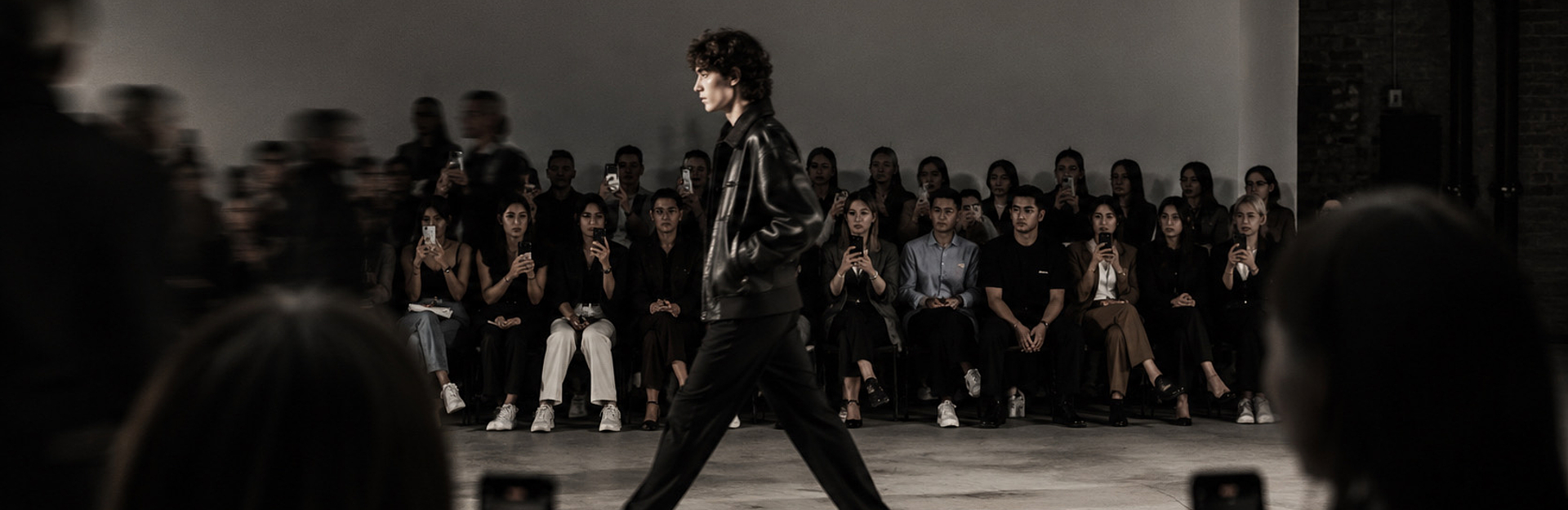
Thousands of creators arrive in the same city, orbit the same shows, walk the same streets. They film what catches their eye and post what they actually like. No brief. No fee. No one asking. Whatever they choose to point a camera at is the closest thing this industry ever gets to an unpaid, unfiltered verdict on what is working and what is not.
That isn't a failure of effort. It's structural. Fashion Week moves faster than any team can watch it. A look is filmed, posted, and buried inside an afternoon. The moment that should have shaped the next casting call, the next seeding list, the next campaign is gone before anyone in the building noticed it happened. The industry has spent decades perfecting how to create attention during these four days. It has spent almost none learning how to read it.
In Berlin, that gap is wider than anywhere and worth more. This is a city where aesthetics tend to arrive before they have a name: where subculture becomes fashion, where an emerging designer can set a direction a full season before the press catches up. The official record here is thinnest precisely where the signal is richest. Which means the brand that can actually read Berlin has access to something its competitors can't even see yet.
Fashion marketing has always run in two separate worlds. Awareness at the top: shows, press, seeding, editorial. Performance at the bottom: paid social, conversion, retargeting. For a long time, keeping them apart made sense. Different teams, different budgets, different clocks.
The creator who films a jacket outside a venue isn't only generating awareness. If that clip lands, it is also the single strongest paid asset the brand could ask for: authentic, unscripted, visually credible, and already proven to hold a real audience's attention before a cent of media touched it. The distance between a street-style moment and a live Meta or TikTok campaign used to be measured in weeks of agency back-and-forth. It is now measured in hours, because the same clip can be read, scored for whether it would actually perform behind spend, and routed into activation almost as fast as it was posted.Brands that treat Fashion Week as pure visibility leave that value on the pavement. Every creator post is three things at once: a signal about the brand's cultural position, a finished content asset, and a potential performance trigger. The brands that start operating on all three will turn four days of momentum into revenue at a speed the awareness-and-performance-as-separate-departments model simply cannot match.
For years, Fashion Week measurement has rested on a single mechanic: the hashtag. Tagged post, counted. No tag, invisible.
Anyone who has spent a season on the ground knows how thin that picture is. Creators film a full look and never name the label. A street-style clip pulls six figures of views with no mention, no tag, no brief. An aesthetic gets referenced across dozens of accounts and not one of them shows up in the brand's recap. The hashtag was never a measurement system. It was a convenience, and the gap between what actually happened at Fashion Week and what the report says happened has widened every season.
The reason that gap is now closable is that software has learned to look at content the way a stylist does, instead of the way a search engine does. Visual AI can recognize the garment itself: the silhouette, the cut, the styling, the logo, the overall aesthetic, across content that never tagged anyone. It reads the image, not the caption. So the look that resonated without credit is no longer lost. It can be found, attributed, and acted on, sitting in a graph of roughly three million creators and more than eleven million analyzed posts that gives any single clip context: who filmed it, who they reach, and how it sits against everything else moving that week.
The brands that close that gap first will have a sharper read on their own cultural position than they have ever had access to before.
Captured properly, Fashion Week produces something far more valuable than content. It produces signals.
Which creators are gravitating toward which aesthetics, unprompted? Which garments are being filmed again and again, organically? Which labels are entering conversations they had no part in last season? Which designers are building momentum that hasn't reached the press yet, but will?
None of that lives in a hashtag feed. It lives in the visual texture of thousands of posts made by people reacting honestly to what they saw. Reading that isn't a human-bandwidth problem you can solve with a bigger recap team. It's an infrastructure problem, and infrastructure problems have solutions.
The useful version of that infrastructure does three things. It recognizes what's actually in the content, untagged. It tracks which creator communities are moving toward a brand and which are quietly drifting away. And it measures share of voice not in a vacuum but against the full competitive set: how a brand performed relative to every other label in its category, across the same four days, in the same city.
And this matters: good measurement is allowed to have an opinion. A system worth trusting doesn't flatter you by counting everything. It tells you what's off-brand, what's below the bar, what isn't worth your spend. In practice, that means saying no to a meaningful share of what gets filmed, roughly one post in six. A measurement layer that approves of everything isn't measuring. It's applauding.
Better data during the four days is valuable on its own. The deeper advantage is what happens when that data feeds every decision that follows.
Which creators over-performed relative to their following? Which organic clip kept converting once it was put behind paid spend? Which audience responded hardest? Those answers don't just sharpen the post-event debrief, they sharpen the next seeding list, the next brief, the next casting decision. And when the results of paid and affiliate activation flow back into the system, the model's instincts retrain on a cadence of about two weeks, so each cycle starts from harder evidence than the last.
This is the line between brands building a loop and brands running one-offs. One Fashion Week's intelligence informs the next. One seeding activation sharpens the one after it. Over time, the distance between a brand operating this way and a brand that isn't becomes very hard to close, not because the tools are locked away, but because the accumulated learning is.
What to do with the four days
The practical applications are more immediate than they sound.
In the days right after the shows, it's possible to identify which creators genuinely aligned with a brand's aesthetic without being paid to. Those are the strongest seeding targets for the season ahead and the most credible candidates for paid partnerships that will actually perform, because the affinity is already on the record.
The organic content that resonated most during the event is also the content most likely to convert when amplified. Moving fast on rights and scaling the strongest material into paid while the cultural moment is still warm is a real edge over the brand still waiting on an agency to assemble a summary.
And beyond any single brand, Fashion Week is one of the only moments when an entire industry is visible at once. Knowing what competitors activated, which creators they worked with, and where new labels are gaining traction is strategic intelligence, and most brands are currently generating it for their rivals simply by not capturing it themselves.
Fashion Week has always rewarded creative vision. That won't change.
But the next competitive frontier in fashion isn't creative. It's operational. The ability to move fast on the right signals, to connect awareness to performance without losing the weeks in between, and to build a system that learns from every activation instead of starting from zero each season.
Four days of Berlin, read properly, should inform four seasons of decisions.
Most brands will leave with photos. The ones building a real advantage will leave with a system.
Written by Simon Fransson, Founder of Settr.
Settr is an official tracking partner of Berlin Fashion Week SS27, taking place 2–5 July in Berlin.
For more, visit settr.com or reach out directly to Johanna Orthey, Market Lead DACH, at jo@settr.com or sf@settr.com.


