
News
Fashion collections don’t emerge in a vacuum. They take shape in ateliers, studios, streets and cities—in places that can, in their own way, inspire the people who create them. But how exactly? That’s what we want to find out in our new interview series.
Designers who regularly present their collections as part of Berlin Fashion Week show us around the neighbourhoods of their studios, sharing not only the places, streets and cityscapes that surround them, but also the inspirations and ideas behind their work and their approach to fashion. Johann Ehrhardt of Haderlump Atelier Berlin kicks things off—and takes us surprisingly far beyond his own neighbourhood.
We meet Johann on a sunny autumn day at Maybachufer, several kilometres from his Kreuzberg atelier. Yet the designer can often be found here on Tuesdays and Fridays, when the popular weekly market sets up along the picturesque canal.
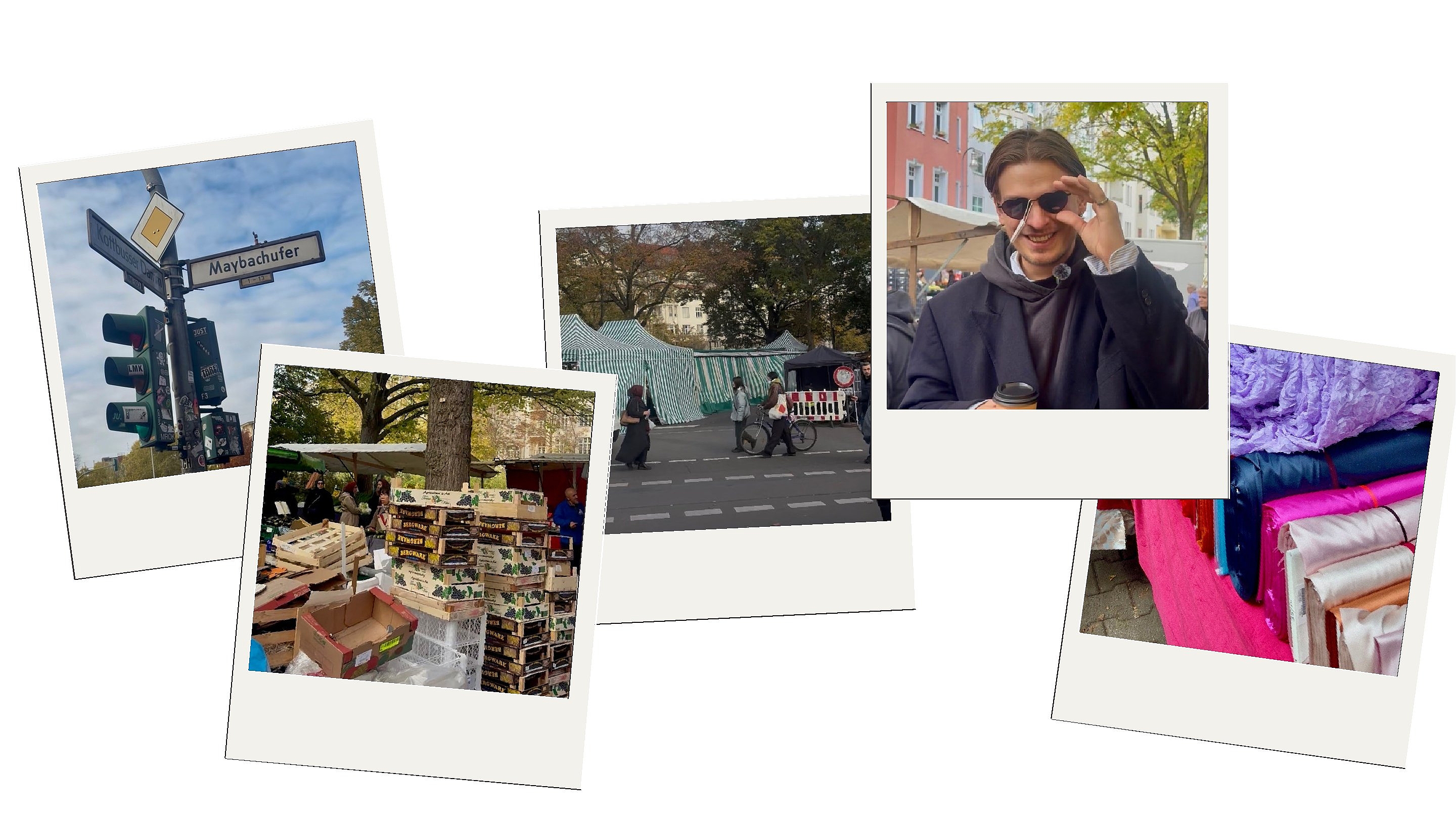
The first market was held here as early as 1881, when farmers from the surrounding countryside came to sell their fruit and vegetables to the growing urban population. Decades later, the Maybachufer market has become a true Berlin institution, always bustling with activity: Traders call out loudly to attract passing customers, lay out their goods and replenish their stalls with fresh crates, while shoppers haggle and jostle their way through the crowds.
On the day we meet Johann, Maybachufer is particularly busy. Hundreds of people squeeze past the market stalls; it’s noisy and bustling, with clouds of steam drifting over from a Köfte stand. Even so, Johann’s tall figure is easy to spot from a distance. “There are so many reasons why this market is one of my absolute favourite places in Berlin,” he says with a gentle smile.
Johann bought his first fabrics here, he tells us, back when he was studying fashion design at Lette Verein Berlin. “I quickly realised that all the students came here looking for materials because they were so affordable.” Indeed, the market is known not only for its fruit and vegetables, but also for its extensive selection of textiles.
“Today, we only buy materials here for our prototypes,” says Johann, referring to his label, which he founded in 2021 with his colleague Julius Weißborn. “I always try to find fabrics that are as close as possible to the original materials we eventually use for our collections, most of which we source through a deadstock platform.”
But affordable fabrics for samples aren’t the only reason he enjoys spending time at the Maybachufer market. Nodding towards the lively crowds, Johann explains: “You get all kinds of people here—from creatives looking for materials to locals simply buying their vegetables, as well as tourists keen to discover Kreuzberg.” As a designer, he finds this particularly inspiring: “You get a pretty good impression of Berlin as a whole in just these few square metres.”
So, is it all about people-watching and hunting for fabrics? Nothing else Johann likes to pick up at Maybachufer? “A coffee, sometimes,” he says with a shrug. Otherwise, he sticks to the textile stalls. And even when it comes to coffee, he prefers to go somewhere else if he can—Akkurat Café, the next stop on his list of favourite places in Kreuzberg. So this time, Johann really is taking us right into the immediate vicinity of his atelier.
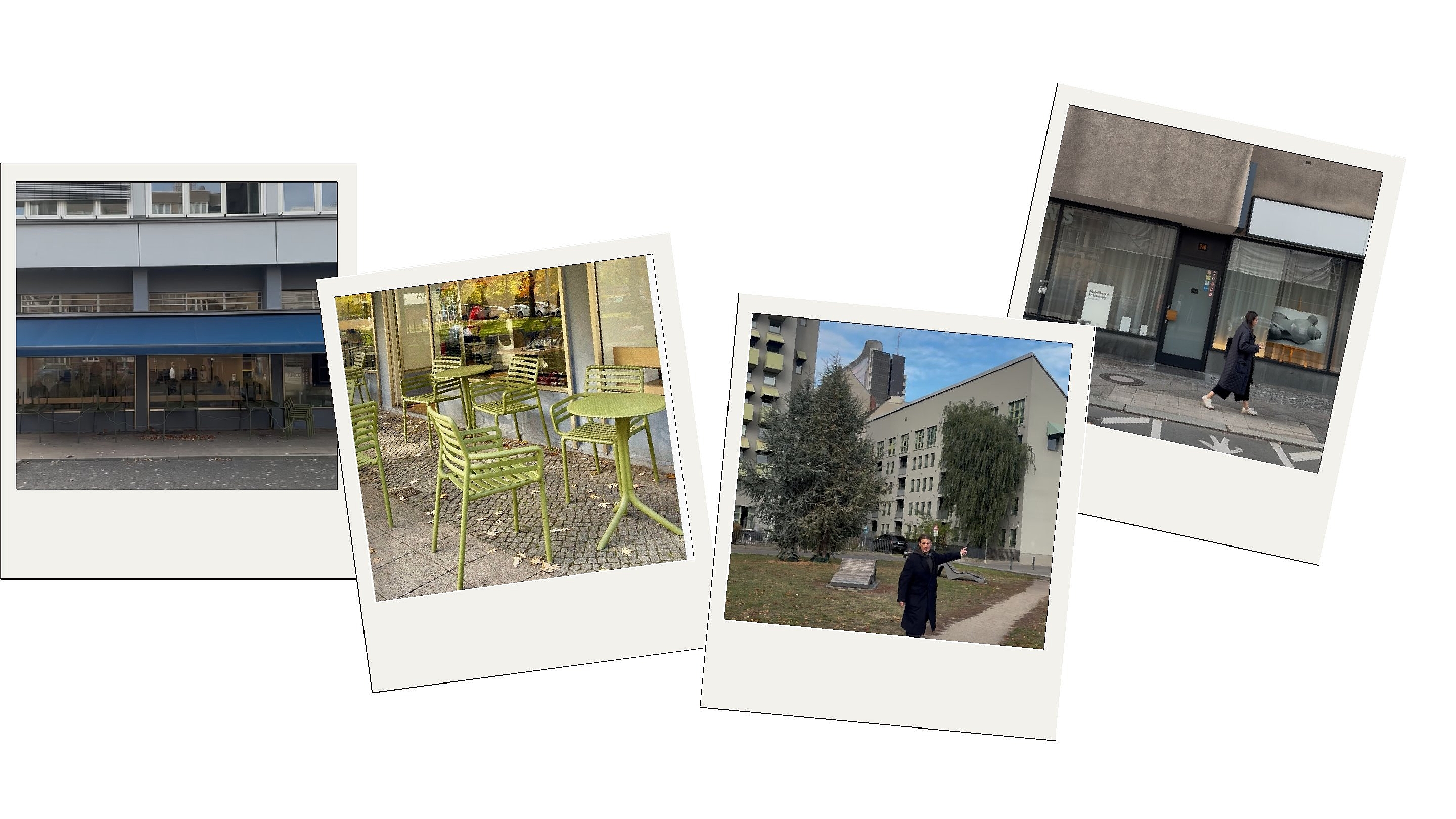
At the end of 2025, Johann, the label’s Creative Director, and CEO Julius moved into their new workspace at Besselstraße 14. For the first time, Haderlump now has its own store alongside its atelier and offices. Why do they particularly enjoy popping into Akkurat Café? The answer is simple: “It’s in the same building, the people are nice and the coffee is good,” Johann says.
“When things get a little too hectic at our place, when 13 people are working away in the run-up to our Berlin Fashion Week show, we like to extend our atelier into the café,” the designer continues. “We can sit outside, take a breath and have a proper conversation without someone constantly coming up to us with yet another question or a completely different topic.”
As for what to order at Akkurat Café, Johann recommends the “Mushroom Miso Toast”: a slice of sourdough topped with creamy mushrooms and Brazil nut crumble. “Otherwise, we just pick something up for lunch at the nearest supermarket, or pop into Umami for a plate of noodles.” If possible, he says, he eats noodles “anytime, anywhere”.
And yet the final spot Johann wants to show us isn’t the cosy Vietnamese restaurant around the corner. Instead, he takes us to Nobelhart & Schmutzig, just a few streets away—a Michelin-starred restaurant where he has never actually eaten. “I included Nobelhart & Schmutzig in my list anyways because I know some really cool people who have worked with the restaurant—designing its graphic identity, interior or glassware, for example.”
He would like to finally eat there one day, Johann says, not least because of its unusual name, as “schmutzig“ is the German word for “dirty“. “I think it’s incredibly bold to put that word in the name of a restaurant of all places,” he says with a laugh. In fact, the name was borrowed from a headline in the Frankfurter Allgemeine Sonntagszeitung: “Nobel, hart und schmutzig”—roughly translated as “posh, tough and dirty”—was the title of an article about polo.
For owner Billy Wagner, a true fixture of Berlin’s restaurant scene, the phrase also captures the experience of dining at a good restaurant, as he has explained in interviews: You start the evening posh, get a little tougher as the night goes on and, ideally, end up thoroughly dirty. Our walk with Johann, by contrast, comes to a rather clean end—in Haderlump’s minimalist store.
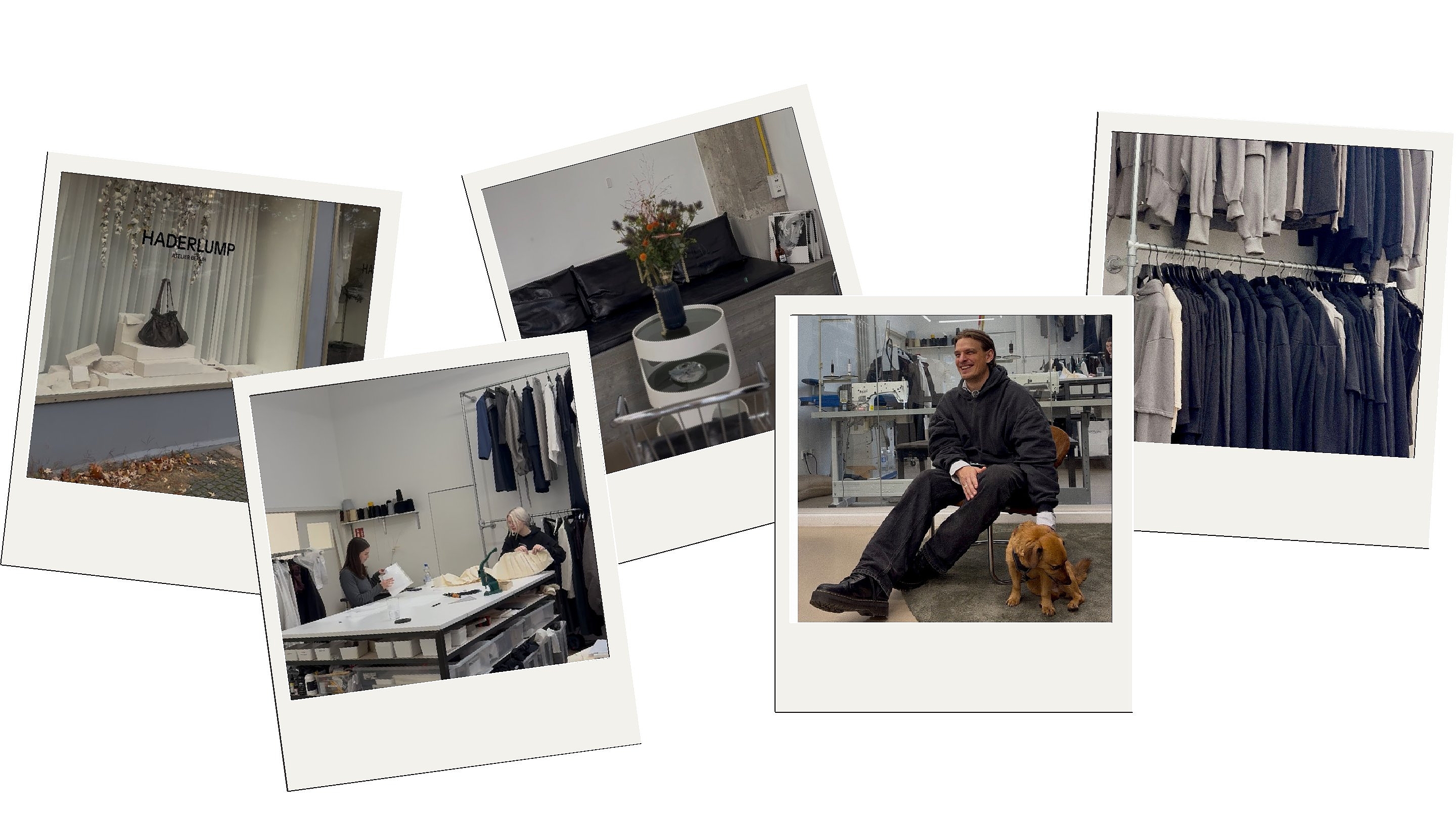
Raw concrete throughout, grey floors, grey walls, and a modernist chandelier as a decorative focal point: the space perfectly complements the label’s rather rough-edged collections. And customers can get a close-up look at how these pieces come to life at Besselstraße 14.
The brand’s retail and workspace have been conceived as a kind of glass atelier: from the front of the store, large panoramic windows offer a view into the rooms behind, where cutting tables and sewing machines stand side by side. On this autumn day, Johann’s team is hard at work there, too.
“Julius and I always thought that a shop modelled a little on a bakery would suit us,” Johann says. “Customers can see what’s being baked in the back and buy the bread straight from the counter at the front.” The fact that his atelier, his store, his bakery, if you like, is now located in this particularly special part of Kreuzberg makes the whole concept even better.
“It’s a relatively quiet neighbourhood, but you’re only a few minutes away from the heart of Kreuzberg around Maybachufer or from Potsdamer Platz,” Johann says with a smile. “So we’re right in the middle of everything, yet a little tucked away—a bit of a hidden gem.”


